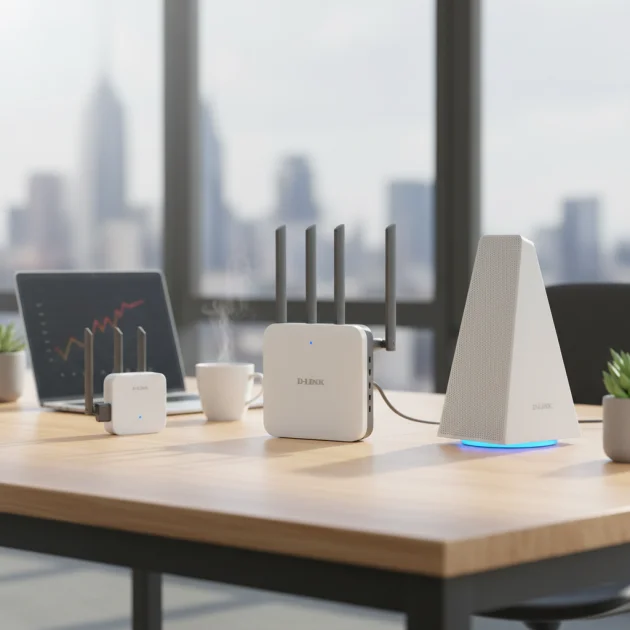
The D-Link DAP-1820 AC2600 Mesh Wi-Fi Range Extender is the best D-Link WiFi extender for office environments, offering robust coverage and reliable performance for demanding business settings. This model provides speeds up to 2600 Mbps and covers up to 2000 sq ft, making it ideal for maintaining seamless connectivity across multiple devices and users in a professional space. This guide explores key D-Link models, evaluating their features, speed, and overall value to help you make an informed decision for your office’s network infrastructure.
Quick comparison
| Model | Speed (Mbps) | Coverage (sq ft) | Key Feature | Price Range |
|---|---|---|---|---|
| D-Link DAP-1820 AC2600 | Up to 2600 | Up to 2000 | Mesh Wi-Fi support | $100 – $130 |
| D-Link DAP-1720 AC1750 | Up to 1750 | Up to 1500 | Dual-band performance | $70 – $90 |
| D-Link DAP-1620 AC1200 | Up to 1200 | Up to 1000 | Compact design | $50 – $70 |
What Office needs from a WiFi Extender
An office environment demands specific capabilities from a WiFi extender to ensure productivity and smooth operations. Reliability is paramount; dropped connections or inconsistent speeds can severely disrupt work. Offices require extenders that can handle multiple concurrent users and devices, from laptops and smartphones to printers and smart office equipment, without performance degradation. Broad coverage is also essential to eliminate dead zones in larger offices or multi-floor buildings, ensuring every corner has strong signal strength. Security features are critical to protect sensitive business data. Look for WPA3 encryption and robust firewall capabilities. Ease of setup and management is another important factor, minimizing IT overhead. An extender should integrate seamlessly with existing network infrastructure, ideally offering mesh capabilities for a unified network. Finally, future-proofing with support for newer Wi-Fi standards like Wi-Fi 6 (802.11ax) can provide long-term value, accommodating increasing bandwidth demands and device density.
Detailed reviews
D-Link DAP-1820 AC2600 Mesh Wi-Fi Range Extender
The D-Link DAP-1820 AC2600 is an excellent choice for offices requiring extensive coverage and high-speed connectivity. It supports dual-band Wi-Fi with speeds up to 2600 Mbps (800 Mbps on 2.4 GHz and 1733 Mbps on 5 GHz), making it suitable for bandwidth-intensive tasks like video conferencing and large file transfers. Its standout feature is D-Link’s Wi-Fi Mesh technology, which creates a unified network name with compatible D-Link routers, eliminating the need to manually switch networks. This provides a seamless roaming experience for employees moving between different office areas. The DAP-1820 also includes a Gigabit Ethernet port for connecting wired devices, enhancing flexibility. Setup is straightforward via the D-Link Wi-Fi app, and its compact design allows for discreet placement. This extender is ideal for medium to large offices needing reliable, high-performance Wi-Fi.
D-Link DAP-1720 AC1750 Wi-Fi Range Extender
The D-Link DAP-1720 AC1750 offers a strong balance of performance and value for small to medium-sized offices. With combined speeds up to 1750 Mbps (450 Mbps on 2.4 GHz and 1300 Mbps on 5 GHz), it effectively extends existing Wi-Fi signals to eliminate dead zones. The dual-band capability allows for dedicated high-speed connections for critical devices, while the 2.4 GHz band handles general browsing and less demanding tasks. Three external antennas provide enhanced signal strength and coverage, reaching areas that previously had weak or no Wi-Fi. A Gigabit Ethernet port is included for connecting a wired device like a desktop PC or network printer directly to the extender, ensuring a stable connection. The DAP-1720 is easy to set up using a WPS button or the D-Link Wi-Fi app, making it a practical solution for offices seeking improved coverage without a premium price tag.
D-Link DAP-1620 AC1200 Wi-Fi Range Extender
The D-Link DAP-1620 AC1200 is a compact and affordable option for smaller offices or specific areas within a larger office that require a boost in Wi-Fi signal. It delivers combined speeds of up to 1200 Mbps (300 Mbps on 2.4 GHz and 867 Mbps on 5 GHz), which is sufficient for everyday office tasks such as email, web browsing, and standard document collaboration. Its small, wall-plug design makes it unobtrusive and easy to place in any power outlet. Despite its size, it features two external antennas for improved signal reception and transmission. A Fast Ethernet port is also included, allowing for a single wired connection. The DAP-1620 is particularly useful for extending Wi-Fi to a specific conference room, a small annex, or an area with persistent signal weakness. Its simplicity and cost-effectiveness make it a viable choice for basic office Wi-Fi extension needs.
Routine fit
Integrating a D-Link WiFi extender into an office routine significantly enhances daily operations by ensuring consistent connectivity. For offices with frequent video conferences, an extender like the DAP-1820 ensures stable, high-bandwidth connections, preventing interruptions and maintaining professional communication. In open-plan offices, extenders eliminate dead zones, allowing employees to move freely with their laptops without losing connection. For departments handling large file transfers, a dedicated 5 GHz band from an extender can drastically reduce transfer times. Even in smaller offices, an extender can provide reliable Wi-Fi to a reception area or a break room, improving the experience for visitors and staff alike. The ability to connect wired devices via an Ethernet port on the extender also benefits stationary workstations or network printers, ensuring critical devices have the most stable connection possible. This seamless integration supports a productive and efficient work environment.
FAQs
What is the primary benefit of a D-Link mesh extender in an office?
The primary benefit of a D-Link mesh extender, such as the DAP-1820, in an office is the creation of a unified Wi-Fi network. This means all devices connect to a single network name (SSID) regardless of whether they are connected to the main router or the extender. This eliminates the need for employees to manually switch between networks as they move around the office, ensuring seamless roaming and uninterrupted connectivity, significantly improving user experience and network stability across larger office spaces.
Can a D-Link WiFi extender improve internet speed in an office?
A D-Link WiFi extender primarily improves the coverage and signal strength of your existing Wi-Fi network, rather than directly increasing your internet service provider’s speed. However, by extending a strong signal to areas previously suffering from weak Wi-Fi, it can make the effective speed feel faster in those specific locations. This is because devices in weak signal areas often experience slower data rates and more packet loss. By providing a robust connection, the extender ensures devices can utilize the full potential of your existing internet speed in more parts of the office.
How many D-Link extenders can an office use?
The number of D-Link extenders an office can use depends on the size and layout of the space, as well as the specific models chosen. For mesh-enabled extenders like the DAP-1820, you can typically add multiple units to create a larger, seamless mesh network. For traditional extenders, it’s generally recommended to use them strategically to cover specific dead zones. Overlapping coverage too much or using too many extenders can sometimes lead to network congestion or interference. It’s best to start with one or two and assess coverage before adding more, ensuring each extender is placed optimally.
Is WPA3 security important for an office WiFi extender?
Yes, WPA3 security is highly important for an office WiFi extender. WPA3 is the latest and most secure encryption standard for Wi-Fi networks, offering enhanced protection against various cyber threats compared to older standards like WPA2. In an office environment where sensitive business data is transmitted, robust security is crucial to prevent unauthorized access and data breaches. Using an extender with WPA3 ensures that the extended network segment maintains the highest level of encryption, safeguarding confidential information and maintaining network integrity.
What is the ideal placement for a D-Link WiFi extender in an office?
The ideal placement for a D-Link WiFi extender in an office is roughly halfway between your main router and the area where you need improved Wi-Fi coverage. It should be placed in a location where it can still receive a strong signal from the main router, indicated by the extender’s signal strength LED. Avoid placing it in corners, near large metal objects, or close to other electronics that might cause interference. Placing it too far from the router will result in the extender receiving a weak signal, which it will then only amplify poorly. Optimal placement ensures the extender can effectively re-broadcast a strong, stable signal.
Verdict
For offices seeking the best D-Link WiFi extender, the D-Link DAP-1820 AC2600 Mesh Wi-Fi Range Extender stands out as the top recommendation. Its high-speed capabilities, extensive coverage, and seamless mesh technology provide a robust and reliable network solution for demanding business environments. While the DAP-1720 offers a strong balance of performance and value for smaller offices, and the DAP-1620 serves well for targeted signal boosts, the DAP-1820’s comprehensive features ensure consistent, high-quality connectivity across an entire office space. Investing in the right D-Link extender guarantees a productive and uninterrupted workflow for all employees.
Frequently Asked Questions
What is the primary benefit of a D-Link mesh extender in an office?
The primary benefit of a D-Link mesh extender, such as the DAP-1820, in an office is the creation of a unified Wi-Fi network. This means all devices connect to a single network name (SSID) regardless of whether they are connected to the main router or the extender. This eliminates the need for employees to manually switch between networks as they move around the office, ensuring seamless roaming and uninterrupted connectivity, significantly improving user experience and network stability across larger office spaces.
Can a D-Link WiFi extender improve internet speed in an office?
A D-Link WiFi extender primarily improves the coverage and signal strength of your existing Wi-Fi network, rather than directly increasing your internet service provider's speed. However, by extending a strong signal to areas previously suffering from weak Wi-Fi, it can make the effective speed feel faster in those specific locations. This is because devices in weak signal areas often experience slower data rates and more packet loss. By providing a robust connection, the extender ensures devices can utilize the full potential of your existing internet speed in more parts of the office.
How many D-Link extenders can an office use?
The number of D-Link extenders an office can use depends on the size and layout of the space, as well as the specific models chosen. For mesh-enabled extenders like the DAP-1820, you can typically add multiple units to create a larger, seamless mesh network. For traditional extenders, it's generally recommended to use them strategically to cover specific dead zones. It's best to start with one or two and assess coverage before adding more, ensuring each extender is placed optimally.
Is WPA3 security important for an office WiFi extender?
Yes, WPA3 security is highly important for an office WiFi extender. WPA3 is the latest and most secure encryption standard for Wi-Fi networks, offering enhanced protection against various cyber threats compared to older standards like WPA2. In an office environment where sensitive business data is transmitted, robust security is crucial to prevent unauthorized access and data breaches. Using an extender with WPA3 ensures that the extended network segment maintains the highest level of encryption, safeguarding confidential information and maintaining network integrity.
What is the ideal placement for a D-Link WiFi extender in an office?
The ideal placement for a D-Link WiFi extender in an office is roughly halfway between your main router and the area where you need improved Wi-Fi coverage. It should be placed in a location where it can still receive a strong signal from the main router, indicated by the extender's signal strength LED. Avoid placing it in corners, near large metal objects, or close to other electronics that might cause interference. Optimal placement ensures the extender can effectively re-broadcast a strong, stable signal.
Get our weekly buyer guide
Practical specs, not advice. Unsubscribe anytime.
I picked up the D-Link DAP-1720 AC1750 for my home office, hoping to boost the signal in my detached garage. While it definitely improved things, I was a bit disappointed that it didn’t quite reach the full 1500 sq ft coverage as advertised for my specific setup. It works well for the main house, but the garage still has some weak spots. Maybe I needed the higher-end model.
I recently upgraded our small office network with the D-Link DAP-1820 AC2600, and it’s been a game-changer. We have about 1800 sq ft of office space, and before, we had dead zones in the back rooms. Now, everyone has a strong signal, even with multiple video calls happening simultaneously. The mesh Wi-Fi support really makes a difference for seamless roaming.
Our office was struggling with slow speeds and constant buffering, especially when everyone was online. We decided to invest in the D-Link DAP-1820 AC2600, and the difference is night and day. The speeds are consistently high, even with 15+ devices connected. It’s definitely worth the $100-$130 price tag for the reliability it provides.
The D-Link DAP-1620 AC1200 was exactly what I needed for my small consulting office. It’s super compact and was easy to set up. For the price range of $50-$70, it’s a solid performer. My team can now reliably connect from all corners of our 800 sq ft space without any drops, which is crucial for our client meetings.